-
Courses
Courses
Choosing a course is one of the most important decisions you'll ever make! View our courses and see what our students and lecturers have to say about the courses you are interested in at the links below.
-
University Life

University Life
Each year more than 4,000 choose University of Galway as their University of choice. Find out what life at University of Galway is all about here.
-
About University of Galway

About University of Galway
Since 1845, University of Galway has been sharing the highest quality teaching and research with Ireland and the world. Find out what makes our University so special – from our distinguished history to the latest news and campus developments.
-
Colleges & Schools
Colleges & Schools
University of Galway has earned international recognition as a research-led university with a commitment to top quality teaching across a range of key areas of expertise.
-
Research & Innovation
Research & Innovation
University of Galway’s vibrant research community take on some of the most pressing challenges of our times.
-
Business & Industry
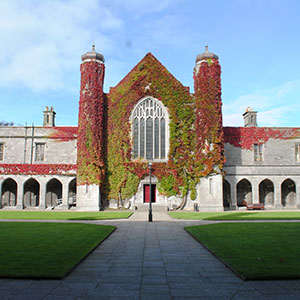
Guiding Breakthrough Research at University of Galway
We explore and facilitate commercial opportunities for the research community at University of Galway, as well as facilitating industry partnership.
-
Alumni & Friends
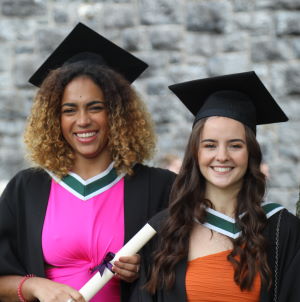
Alumni & Friends
There are 128,000 University of Galway alumni worldwide. Stay connected to your alumni community! Join our social networks and update your details online.
-
Community Engagement
Community Engagement
At University of Galway, we believe that the best learning takes place when you apply what you learn in a real world context. That's why many of our courses include work placements or community projects.
 Accessibility & Language
May Impact of social media on teens may be less than widely assumed
Impact of social media on teens may be less than widely assumed
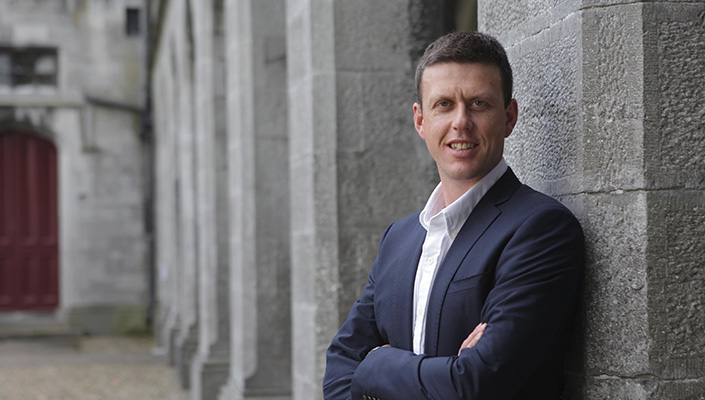
Professor Eoin Whelan, who led the research at University of Galway’s J.E. Cairnes School of Business and Economics. Credit – Aengus McMahon.
May
27
2026
Posted: 10:16 IST
Research from University of Galway suggests that the impact of social media on the health and well-being of teenagers is less than is often feared.
While the study recognises that time spent on social media is linked to a range of health outcomes, the analysis reveals that its influence is relatively modest and smaller than what we assume.
The analysis of surveys of teenagers also showed that the impact of social media was relatively small when compared to other social and environmental factors in young people’s lives.
Professor Eoin Whelan, who led the research at University of Galway’s J.E. Cairnes School of Business and Economics, said the study highlights the limitations of attributing teenage mental health and well-being primarily to social media use.
Professor Whelan said: “The findings of this study are consistent with other prior studies which report that overall, the harmful effects of social media use on adolescent well-being may be smaller than often assumed.”
The research, published in Acta Psychologica, shows that factors such as feeling safe in school, supportive relationships with parents and caregivers and financial ability to participate in activities are more important predictors of adolescent health outcomes.
The study used data from almost 3,000 teenagers aged 15-16 who were living in the West of Ireland and who completed the Planet Youth survey. The analysis involved an advanced method known as specification curve analysis to examine more than 50,000 possible links between social media use and health outcomes.
The study found that:
- Social media use is associated with small differences in adolescent health outcomes.
- Associations between social media use and mental health outcomes tended to be higher for girls, though the overall effect remained small.
- Spending more time on social media was most strongly linked to higher levels of anger difficulties in boys, and to alcohol use and vaping in both boys and girls, though these links were still relatively modest.
- Overall, social media use was not among the strongest predictors of adolescent health outcomes.
Unlike much previous research, the study directly compares social media use with other known influences on adolescent health, such as school safety and parental support, allowing the relative importance of these factors to be assessed more clearly.
The findings suggest that policymakers and caregivers may benefit from focusing on a broader range of factors affecting young people’s health, rather than treating social media as a primary cause of harm.
The study also aligns with a recent consensus report from the American National Academies of Science, Engineering, and Medicine, which found insufficient evidence to conclude that social media causes changes in adolescent health across the wider teenage population.
Professor Whelan continued: “While analysis of information reported by teenagers shows that the negative impact of social media may be overstated, this does not mean that social media is harmless or without risk. Social media can present risks for young people, and those do deserve attention.
“Although there have been thousands of studies investigating the impacts of social media on the lives of young people, we do not have a complete picture. Most research, like my own, has to rely on self-reported data, which has limitations.
“To really find out how social media is impacting young people, researchers need access to data on how teenagers are actually using social media. The EU Digital Services Act requires online platforms to make this data available to vetted researchers. However, the data held by social media companies is difficult to obtain, and when provided, is often incomplete. This hampers the independent scrutiny of the impact of social media platforms - one of the central goals of the Digital Services Act.”
The full study, published in Acta Psychologica, is available to read here
Ends
Related News
15 October 2026
Ollscoil na Gaillimhe ag ceiliúradh agus beagnach 2,800 duine ag fáil a gcéime ag na searmanais bhronnta
15 October 2026
University of Galway celebrates almost 2,800 graduates at conferring ceremonies
14 October 2026
University of Galway awarded Jean Monnet Centre of Excellence
13 October 2026
European research partnership to strengthen child protection and wellbeing
9 October 2026
Atlantic Summit Galway 2026 concludes with release of Statement to support a sustainable and prosperous ocean future
Featured Stories
Thursday,
15
October
2026
Ollscoil na Gaillimhe ag ceiliúradh agus beagnach 2,800 duine ag fáil a gcéime ag na searmanais bhronnta
Thursday,
15
October
2026
University of Galway celebrates almost 2,800 graduates at conferring ceremonies
Wednesday,
14
October
2026