-
Courses

Courses
Choosing a course is one of the most important decisions you'll ever make! View our courses and see what our students and lecturers have to say about the courses you are interested in at the links below.
-
University Life
University Life
Each year more than 4,000 choose University of Galway as their University of choice. Find out what life at University of Galway is all about here.
-
About University of Galway

About University of Galway
Since 1845, University of Galway has been sharing the highest quality teaching and research with Ireland and the world. Find out what makes our University so special – from our distinguished history to the latest news and campus developments.
-
Colleges & Schools
Colleges & Schools
University of Galway has earned international recognition as a research-led university with a commitment to top quality teaching across a range of key areas of expertise.
-
Research & Innovation

Research & Innovation
University of Galway’s vibrant research community take on some of the most pressing challenges of our times.
-
Business & Industry
Guiding Breakthrough Research at University of Galway
We explore and facilitate commercial opportunities for the research community at University of Galway, as well as facilitating industry partnership.
-
Alumni & Friends

Alumni & Friends
There are 128,000 University of Galway alumni worldwide. Stay connected to your alumni community! Join our social networks and update your details online.
-
Community Engagement
Community Engagement
At University of Galway, we believe that the best learning takes place when you apply what you learn in a real world context. That's why many of our courses include work placements or community projects.
 Accessibility & Language
Data-Driven Jacking Pipe Performance in Microtunnelling
PROJECT OVERVIEW
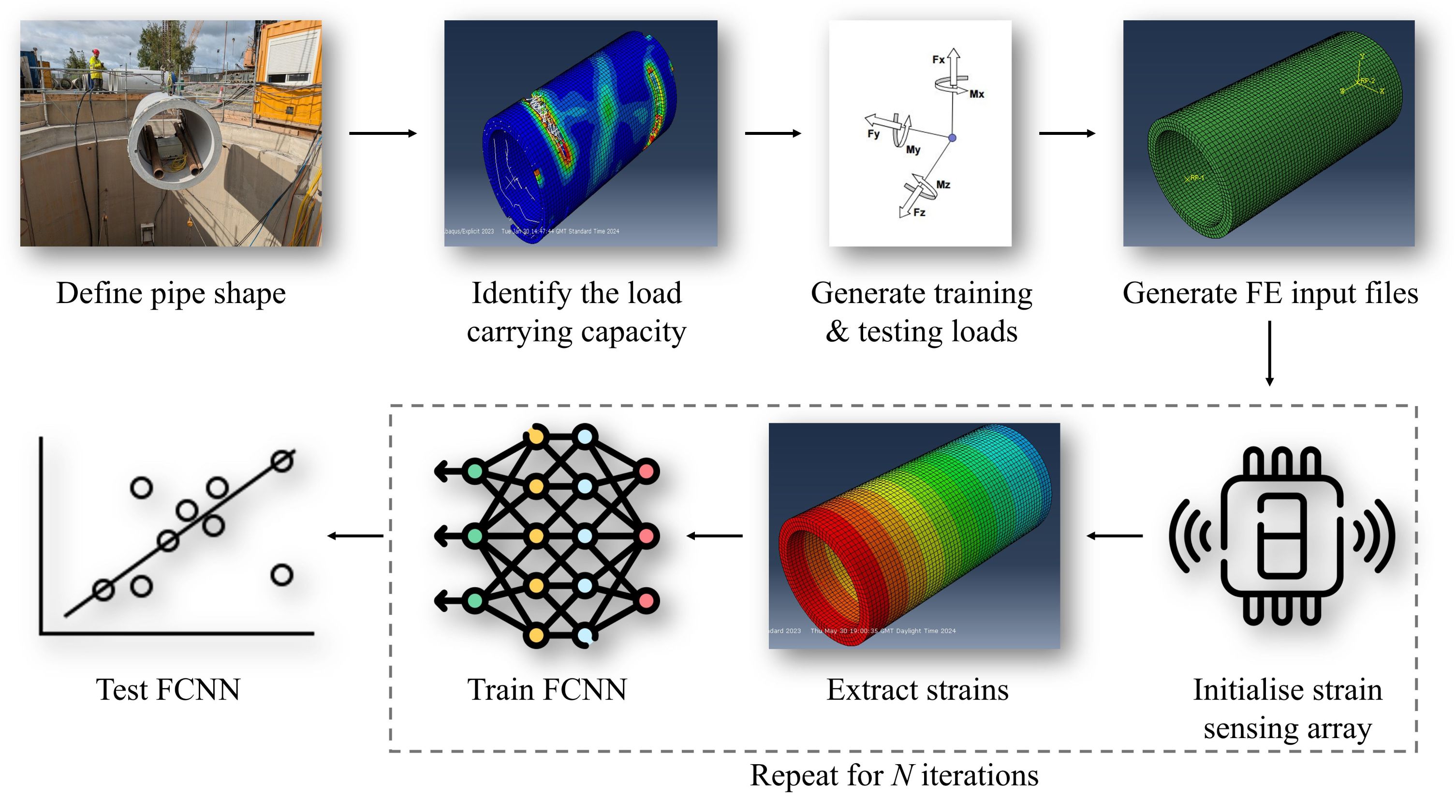
This project investigates the structural behaviour of jacking pipes in microtunnelling, with a focus on performance during installation in curved drives. It combines full-scale field monitoring, laboratory testing, and numerical modelling to better understand how pipes respond to complex construction conditions.
Instrumented pipes installed on the Athlone Main Drainage Scheme provide detailed strain, load, and pressure data, which is analysed using data-driven methods including machine learning to reconstruct in-service loading and improve interpretation of measured responses.
WHY IT MATTERS
- Improves understanding of how jacking pipes behave during real microtunnelling operations
- Provides field-based evidence from full-scale infrastructure works in curved drives
- Identifies key damage mechanisms linked to misalignment and reduced joint contact
- Enables more accurate prediction of construction-stage loads using sensor data and machine learning
- Supports better, safer, and more efficient jacking pipe design practices
- Contributes to improved guidance for microtunnelling design and construction standards
ABSTRACT
Microtunnelling (MT), also known as pipe-jacking, is a trenchless pipeline construction technology in which a series of jacking pipes is pushed between a launch shaft and a reception shaft while a tunnel boring machine excavates the soil ahead of the pipeline. The ‘Smart Pipe’ project aims to improve understanding of the MT process, with a particular focus on the structural design and behaviour of jacking pipes. As part of the project, three full-scale jacking pipes were instrumented and deployed in two MT drives incorporating curves as part of the Athlone Main Drainage Scheme upgrade project in Ireland. The instrumented pipes incorporated embedded fibre Bragg grating strain sensors and vibrating wire strain gauges to monitor concrete deformations, together with multi-axis load cells and pressure transducers to monitor normal and shear stresses, as well as lubricant pressures, during the construction process.
Furthermore, a machine learning framework was developed to reconstruct the six-degree-of-freedom loading acting on jacking pipes from embedded strain sensor measurements. The framework was trained using finite element simulations and validated through laboratory-scale experimental testing. The instrumented pipes were monitored continuously from casting through to the completion of tunnelling works. An improved method was also developed to separate temperature-induced and mechanically induced strains by accounting for the changing boundary conditions of the jacking pipe during construction, departing from the commonly assumed free-boundary conditions.
Detailed analysis of the field measurements identified a reduction in the joint contact area between adjacent pipes due to pipeline misalignment and curvature as a key factor contributing to pipe damage. Based on these findings, recommendations for improved jacking pipe design practice were proposed. The research provides a practical basis for improving the assessment of pipe loading during construction and informing future jacking pipe design guidelines.
Supervisors:
Dr Bryan McCabe, BA, BAI, PhD, CEng, EurIng, MIEI
Dr Brian Sheil, BE, Ph.D.

Asad Wadood | PhD researcher in Civil Engineering
Asad Wadood is a PhD researcher in Civil Engineering at the University of Galway, specialising in geo-structural engineering and trenchless construction. His research focuses on the structural behaviour and design of jacking pipes used in microtunnelling, with particular emphasis on understanding pipe loading during construction. His work combines full-scale field monitoring, finite element modelling and machine learning to investigate the behaviour of jacking pipes under real construction conditions. This includes the development of instrumented jacking pipes incorporating fibre Bragg grating and vibrating wire strain sensors, as well as methods for reconstructing pipe loading from measured strains. His work aims to improve understanding of pipe–soil interaction and the structural behaviour of jacking pipes, ultimately contributing to improved design practice.in Connect with Asad
Publications
A Wadood, BA McCabe, BB Sheil - Underground Space, 2025 Field monitoring and instrumentation in microtunnelling/pipe jacking: A review and future directions
A Wadood, BA McCabe, BB Sheil - 29th European Young Geotechnical Engineers Conference (Rijeka, Croatia), 2025, 131-135 Fibre Bragg grating strain data from a concrete jacking pipe
KG O’Dwyer, A Wadood, BA McCabe, BB Sheil, BM Phillips, 2024 Selected collective learnings from a pipe-jacking drive database
Asad Wadood, Brian B. Sheil, Bryan A. McCabe - Proceedings of the 6th International Conference in Information Technology in Geo-engineering, Budapest, Hungary, 2026 Towards pipes as six DOF load cells: application to microtunnelling
Asad Wadood, Bryan A McCabe, Brian B Sheil, Ronan Royston, Laura Willis, Kevin G O'Dwyer, Bryn M Phillips - 21st International Conference on Soil Mechanics and Geotechnical Engineering, 2026 Development and deployment of instrumented microtunnelling jacking pipes for the Athlone Main Drainage Scheme, Ireland: practical aspects and lessons learned