-
Courses

Courses
Choosing a course is one of the most important decisions you'll ever make! View our courses and see what our students and lecturers have to say about the courses you are interested in at the links below.
-
University Life
University Life
Each year more than 4,000 choose University of Galway as their University of choice. Find out what life at University of Galway is all about here.
-
About University of Galway
About University of Galway
Since 1845, University of Galway has been sharing the highest quality teaching and research with Ireland and the world. Find out what makes our University so special – from our distinguished history to the latest news and campus developments.
-
Colleges & Schools
Colleges & Schools
University of Galway has earned international recognition as a research-led university with a commitment to top quality teaching across a range of key areas of expertise.
-
Research & Innovation

Research & Innovation
University of Galway’s vibrant research community take on some of the most pressing challenges of our times.
-
Business & Industry
Guiding Breakthrough Research at University of Galway
We explore and facilitate commercial opportunities for the research community at University of Galway, as well as facilitating industry partnership.
-
Alumni & Friends

Alumni & Friends
There are 128,000 University of Galway alumni worldwide. Stay connected to your alumni community! Join our social networks and update your details online.
-
Community Engagement
Community Engagement
At University of Galway, we believe that the best learning takes place when you apply what you learn in a real world context. That's why many of our courses include work placements or community projects.
 Accessibility & Language
March Astronomy student discovers second planet around young star
Astronomy student discovers second planet around young star
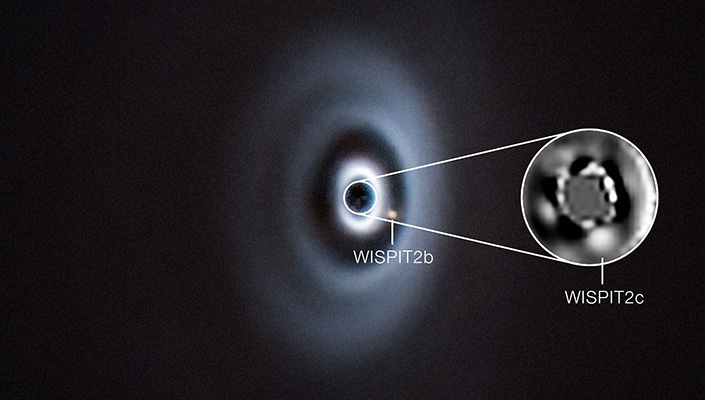
Very Large Telescope images of two planets (WISPIT 2b and the newly discovered WISPIT 2c) forming around the young star WISPIT 2. Photo credit: ESO/C. Lawlor, R. F. van Capelleveen et al.
Mar
24
2026
Posted: 12:36 GMT
An international team of astronomers, led by a PhD student at University of Galway, have made the groundbreaking discovery of a second planet in the same system where they discovered another planet last year.
Detected at an early stage of formation in the disc around a young star, the young planet named WISPIT 2c is estimated to be about 5 million years-old and most likely ten times the mass of Jupiter.
The star, WISPIT 2 is located in the constellation of the Eagle, a prominent equatorial constellation visible in the summer northern hemisphere (July-November) along the Milky Way.
The study was led by PhD student Chloe Lawlor from the Centre for Astronomy at the School of Natural Sciences and the Ryan Institute at University of Galway, in collaboration with PhD student Richelle van Capelleveen, Leiden Observatory, Netherlands and postdoctoral researcher Guillaume Bourdarot, Max Planck Institute for Extraterrestrial Physics in Garching, Germany.
This major find for the field of astronomy makes WISPIT 2 only the second-known young (and still forming) multi-planet system. WISPIT 2 may resemble the young Solar System with now two gas giant planets embedded in its multi-ringed dust disk. This includes the now confirmed planet WISPIT 2c and the planet WISPIT 2b, which was discovered last year by the same research team (led by Richelle van Capelleveen at Leiden Observatory and Dr. Laird Close from the University of Arizona).
The new planet is a very young gas giant based on the temperature and its radius from the atmosphere spectrum. It is twice as massive as the previously detected WISPIT 2b and orbits four times closer to its host star, which makes it incredibly difficult to detect with ground-based telescopes.
The study has been published in Astrophysical Journal Letters.
The presence of this second planet was detected using the European Southern Observatory’s (ESO’s) Very Large Telescope in Chile’s Atacama Desert. By linking several telescopes together to act as one giant instrument, the research team was able to observe regions very close to the star.
The team detected carbon monoxide gas, a chemical that is commonly found in the atmospheres of young giant planets. Carbon monoxide leaves a strong and distinctive chemical signature in telescope data, providing the crucial evidence needed to confirm the planet’s existence.
Chloe Lawlor, PhD student, Centre for Astronomy, School of Natural Sciences, University of Galway, said: “After the initial discovery of WISPIT 2b, which I was also involved in, we suspected there might be another object in the system. At first, we weren’t sure if it was a planet or a very large dust clump. We very quickly made follow-up observations using the Very Large Telescope Interferometer, an incredible setup where multiple telescopes can be connected to form a large virtual telescope. This allowed us to take what we call a spectrum, which is essentially a chemical fingerprint, revealing the elements and molecules in an object’s atmosphere.
“Carbon monoxide is one of the key signatures we are looking for in young giant planets. When we saw it clearly in the data, that was when we knew we had something significant. There was definitely an element of disbelief. I didn’t expect to be the one to find a second planet in the system. When I sent the spectrum to my supervisor Dr Christian Ginski, it was a huge shock and upon further examination, he confirmed I’d found a planet!
“WISPIT 2 will become an important laboratory to study planet formation.”
To uncover the hidden planet, the research team used the European Southern Observatory’s (ESO’s) Very Large Telescope Interferometer (VLTI), which captured an image of the object and allowed also for the first study of its atmosphere. The team specifically used the recently upgraded instrument GRAVITY+, which allows the light from all four of the eight metre telescopes of the ESO to be combined. This challenging technique using cutting-edge instrumentation was fundamental to detecting the new planet, because the star outshines the planet signal by a factor of thousands.
Professor Frances Fahy, Director of the Ryan Institute, University of Galway, said: “The discovery of the planet WISPIT 2c is a remarkable achievement and highlights the world-class astrophysics research taking place at University of Galway. The Ryan Institute is proud to support research that pushes the boundaries of scientific discovery. I warmly congratulate PhD researcher Chloe Lawlor on this breakthrough and Dr Christian Ginski for his leadership and dedication to astronomy research. Discoveries like this capture the imagination and can inspire a whole new generation of astronomers.”
The new discovery offers scientists a rare opportunity to study how massive planets form and evolve, shedding new light on the early processes that ultimately led to the formation of Earth.
Dr Christian Ginski, Lecturer at the School of Natural Sciences, University of Galway, said: “Finding these young planets in formation is the culmination of a lot of work by scientists and engineers alike. When I started out in my career, we had only a few hundred exoplanets discovered (as opposed to the many thousands that we know now) and being able to take a direct image of any planet was considered an incredible challenge. It still boggles my mind that now we are at the level where we can take a peek at the planets as they are forming. I also feel very privileged to work with a whole bunch of brilliant young scientists who know how to make the most of the observational facilities that are now available to us.”
To coincide with the research being published, the European Southern Observatory (ESO) - the world’s foremost international astronomy organisation – has featured a photo of WISPIT 2c and WISPIT 2b forming around the young star WISPIT 2.
The study was supported by the Ryan Institute at University of Galway.
Ends
Related News
15 October 2026
Ollscoil na Gaillimhe ag ceiliúradh agus beagnach 2,800 duine ag fáil a gcéime ag na searmanais bhronnta
15 October 2026
University of Galway celebrates almost 2,800 graduates at conferring ceremonies
14 October 2026
University of Galway awarded Jean Monnet Centre of Excellence
13 October 2026
European research partnership to strengthen child protection and wellbeing
9 October 2026
Atlantic Summit Galway 2026 concludes with release of Statement to support a sustainable and prosperous ocean future
Featured Stories
Thursday,
15
October
2026
Ollscoil na Gaillimhe ag ceiliúradh agus beagnach 2,800 duine ag fáil a gcéime ag na searmanais bhronnta
Thursday,
15
October
2026
University of Galway celebrates almost 2,800 graduates at conferring ceremonies
Wednesday,
14
October
2026