-
Courses

Courses
Choosing a course is one of the most important decisions you'll ever make! View our courses and see what our students and lecturers have to say about the courses you are interested in at the links below.
-
University Life

University Life
Each year more than 4,000 choose University of Galway as their University of choice. Find out what life at University of Galway is all about here.
-
About University of Galway

About University of Galway
Since 1845, University of Galway has been sharing the highest quality teaching and research with Ireland and the world. Find out what makes our University so special – from our distinguished history to the latest news and campus developments.
-
Colleges & Schools
Colleges & Schools
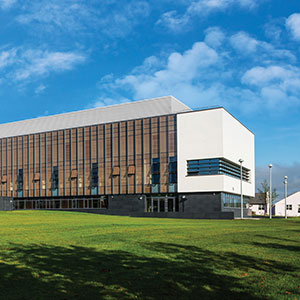
University of Galway has earned international recognition as a research-led university with a commitment to top quality teaching across a range of key areas of expertise.
-
Research & Innovation

Research & Innovation
University of Galway’s vibrant research community take on some of the most pressing challenges of our times.
-
Business & Industry

Guiding Breakthrough Research at University of Galway
We explore and facilitate commercial opportunities for the research community at University of Galway, as well as facilitating industry partnership.
-
Alumni & Friends

Alumni & Friends
There are 128,000 University of Galway alumni worldwide. Stay connected to your alumni community! Join our social networks and update your details online.
-
Community Engagement

Community Engagement
At University of Galway, we believe that the best learning takes place when you apply what you learn in a real world context. That's why many of our courses include work placements or community projects.
 Accessibility & Language
Data Classification
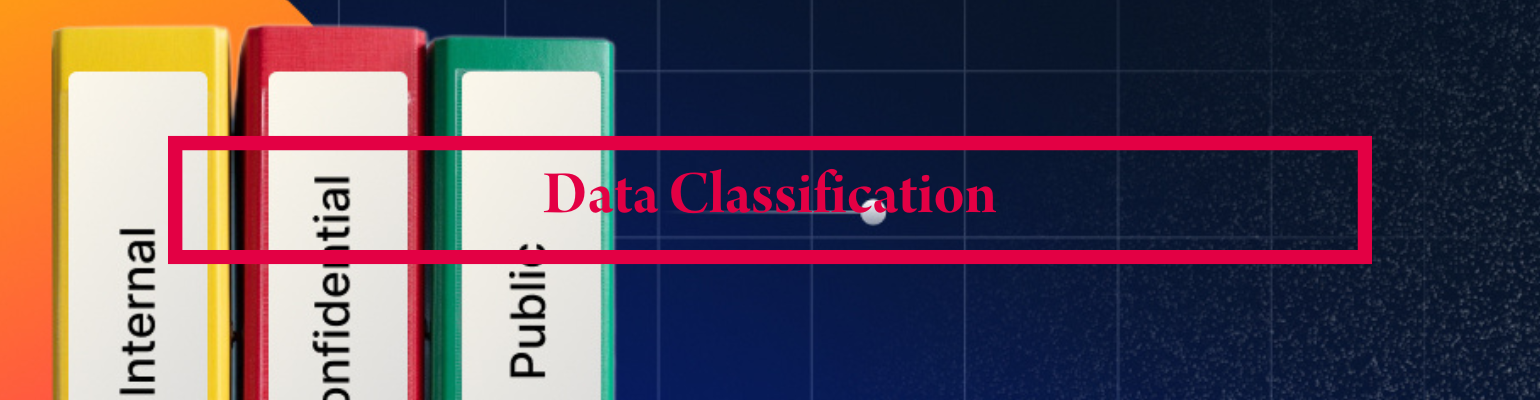
DATA CLASSIFICATION PROJECT IS BEING INTRODUCED ACROSS ALL UNITS.
PLEASE SHARE YOUR FEEDBACK AND QUERIES VIA MS FORM.
Data Classification is the classification of information/data at University of Galway in terms of confidentiality, integrity and availability for the purposes of data protection. The correct classification of data is important to help ensure the prevention of leaks and minimizing the impact of such leaks if they do occur.
A Data Loss Prevention is a security solution that identifies and prevents the unauthorized sharing, transfer, or use of sensitive data. It works by monitoring data at rest (stored), in motion (being transferred), and in use (being processed) across various locations, including on-premises systems, cloud services, and endpoints.
By detecting and blocking risky data activities, DLP will assist the University to prevent data breaches, maintain regulatory compliance, and protect valuable digital assets and intellectual property. In order to implement DLP, the University community will need to commence Data Classification.
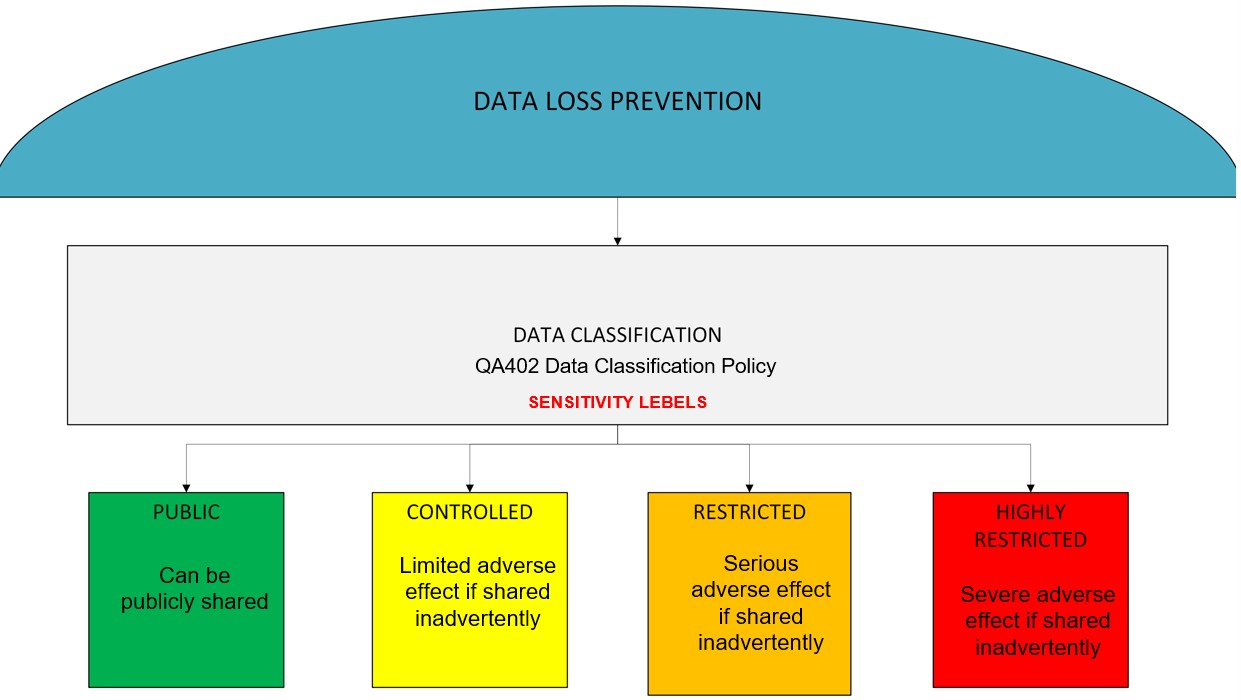
The Data Protection Office, together with ISS, are planning to introduce Data Classification and Data Loss Prevention (‘DLP’) across the University. As an essential step towards Data Loss Prevention, ISS will first implement University-wide Data Classification across the Microsoft Suite of applications – Outlook(Email), Word, Excel and PowerPoint documents.
Data classification levels are described in the University Data Classification Policy (QA402):
| Public | University of Galway Controlled | University of Galway Restricted | University of Galway Highly Restricted |
|---|---|---|---|
|
Public Data is information that can be communicated without restrictions and is intended for general public use. This data will not cause harm to any individual, group, or to the University if made public. |
With this classification protection of information is at the discretion of the data owner and there is a low risk of embarrassment or reputational harm to the University. |
The University has a legal, regulatory or contractual obligation to protect the information with this classification. Disclosure or loss of availability or integrity could cause harm to the reputation of the University or may have short term financial impact on the University. |
Protection of information is required by law or regulatory instrument. The information within this classification is subject to strictly limited distribution within and outside the University. Disclosure would cause exceptional or long-term damage to the reputation of the University or risk to those whose information is disclosed or may have serious or long term negative financial impact on the University. |
| Examples | Examples | Examples | Examples |
| University guidelines and policies; University strategy; course details; public web page, press releases, event details and advertisements. | Meeting minutes; unit working & draft documents | Student or employee records; grades; employee performance reviews; personal identifiable information. | PPS numbers; Physical or mental health record relating to individuals; Critical research. LENS Report. |
Benefits of having data classification in place
Data Classification is an essential element of a robust data governance system, and it will significantly improve data security within the University. It will prevent confidential information being shared with inappropriate recipients and it will minimise risks of sensitive data being disclosed as a result of data protection breaches. Crucially, introducing data classification will help to facilitate the roll out of Microsoft Copilot across all Microsoft accounts where applicable.
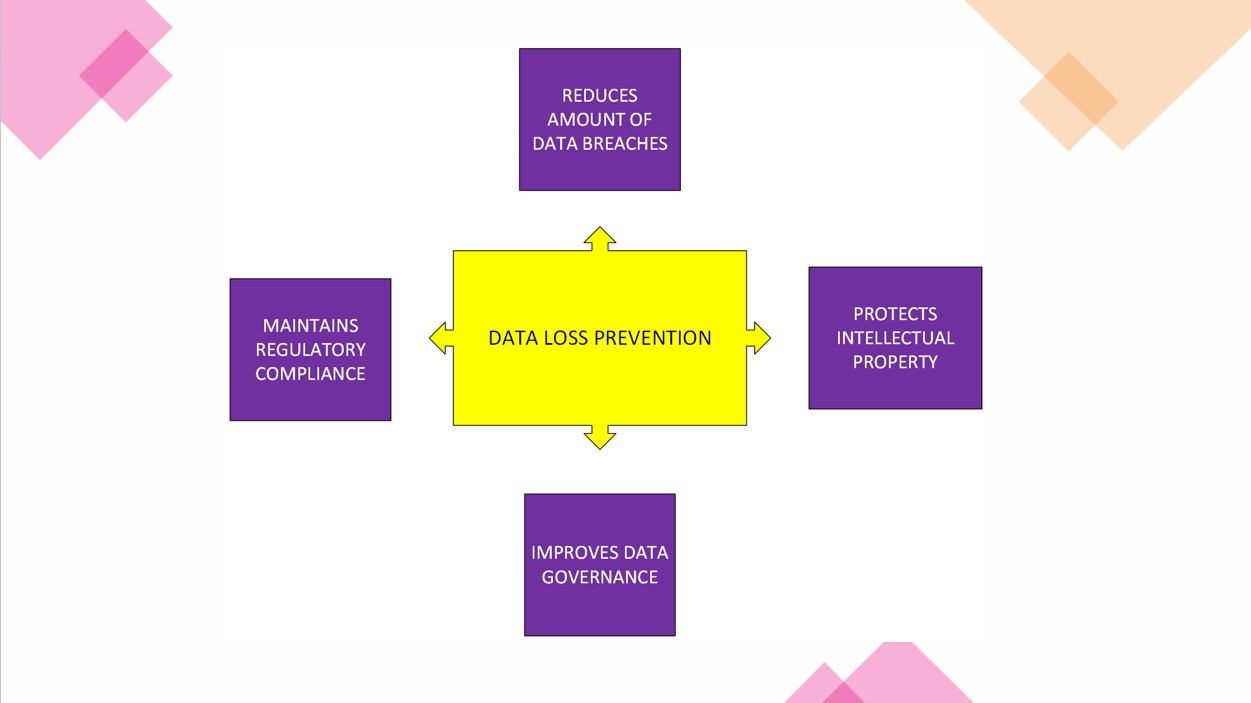
Ultimately, once fully implemented, Data Loss Prevention will assist in risk mitigation, and it will improve overall regulatory compliance, in addition to promoting compliance with University data protection policies. Finally, it will raise awareness of data governance and data protection among staff, contractors and students. Overall having DLP in place will improve the University’s reputation and it will raise its profile.
What happens next?
Data Classification and Data Loss Prevention will be introduced in three phases:
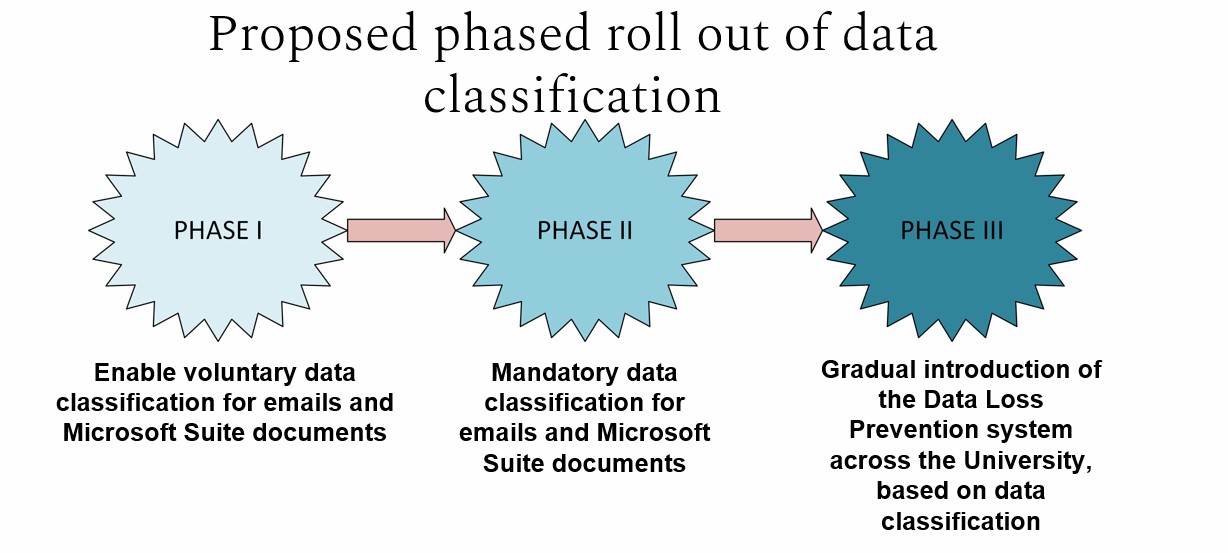
During Phase I (voluntary data classification) the Data Protection Office will run a webinar for all staff explaining how to classify specific types of documents. During Phase I, the Data Protection Office will also encourage staff to submit queries via a Ms Form. Based on those queries, the office will compile the webinar and an FAQ document, which will be published on our webpage.
What will data classification look like in practice?
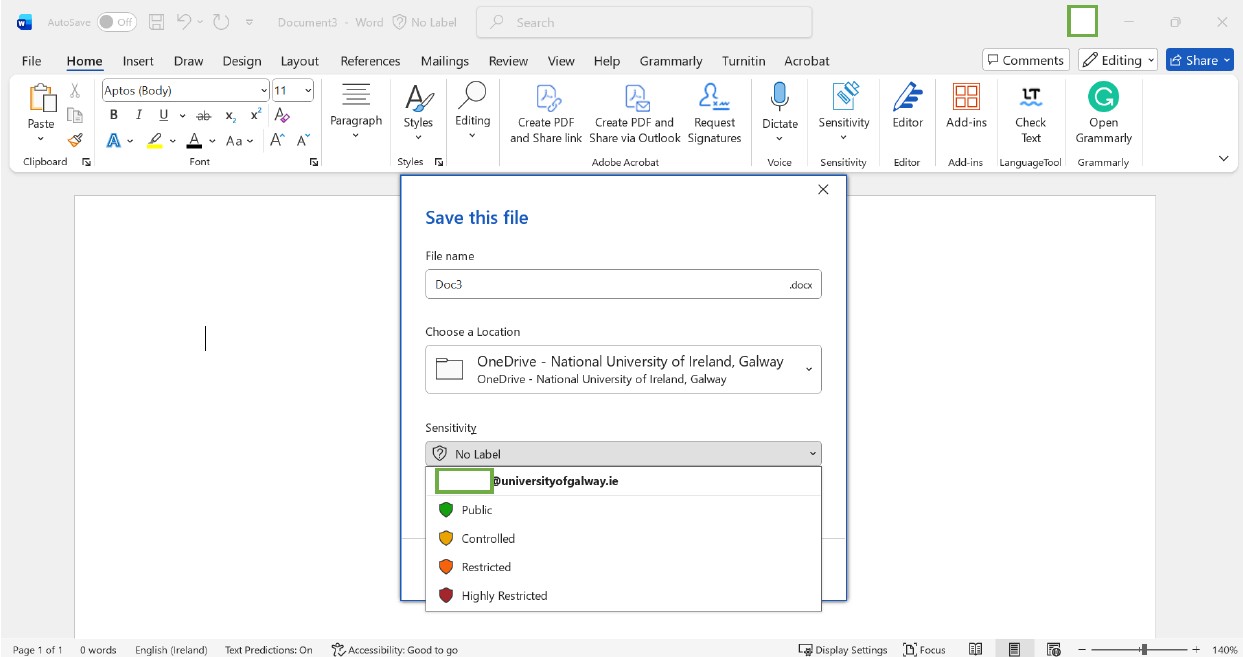
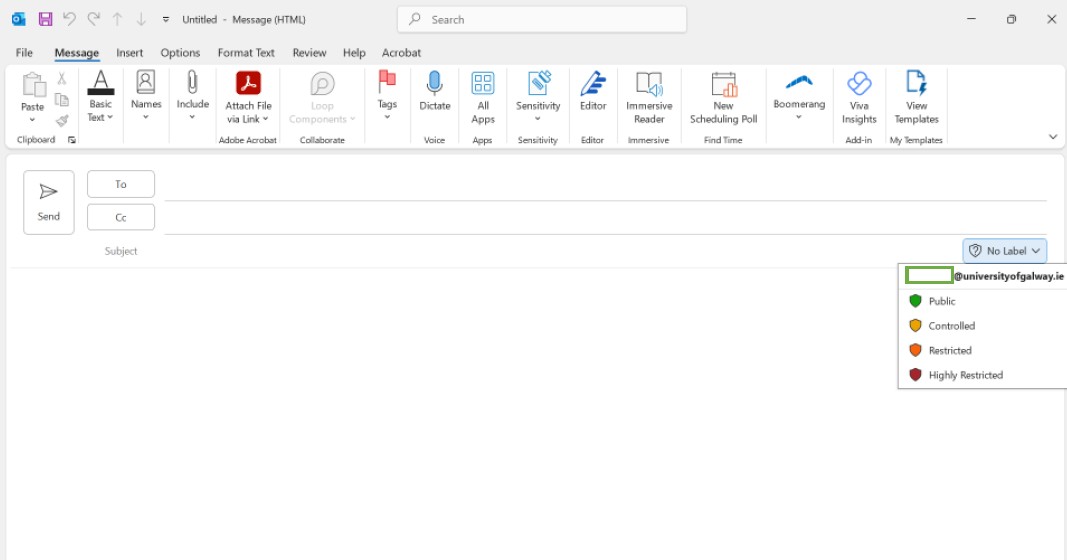
Each staff member will be prompted to select an appropriate sensitivity label when saving a document from the Microsoft Suite of applications – Outlook (Email), Word, Excel and PowerPoint documents (please see examples below).
Data classification will be applied in the following manner:
Emails:
Microsoft Suite documents: