-
Courses

Courses
Choosing a course is one of the most important decisions you'll ever make! View our courses and see what our students and lecturers have to say about the courses you are interested in at the links below.
-
University Life
University Life
Each year more than 4,000 choose University of Galway as their University of choice. Find out what life at University of Galway is all about here.
-
About University of Galway
About University of Galway
Since 1845, University of Galway has been sharing the highest quality teaching and research with Ireland and the world. Find out what makes our University so special – from our distinguished history to the latest news and campus developments.
-
Colleges & Schools
Colleges & Schools
University of Galway has earned international recognition as a research-led university with a commitment to top quality teaching across a range of key areas of expertise.
-
Research & Innovation

Research & Innovation
University of Galway’s vibrant research community take on some of the most pressing challenges of our times.
-
Business & Industry
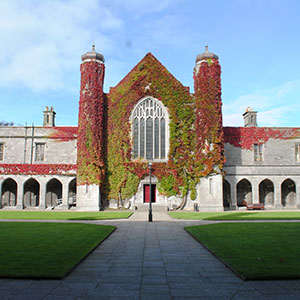
Guiding Breakthrough Research at University of Galway
We explore and facilitate commercial opportunities for the research community at University of Galway, as well as facilitating industry partnership.
-
Alumni & Friends

Alumni & Friends
There are 128,000 University of Galway alumni worldwide. Stay connected to your alumni community! Join our social networks and update your details online.
-
Community Engagement
Community Engagement
At University of Galway, we believe that the best learning takes place when you apply what you learn in a real world context. That's why many of our courses include work placements or community projects.
 Accessibility & Language
Data-Driven Aeration Monitoring and Control
PROJECT OVERVIEW
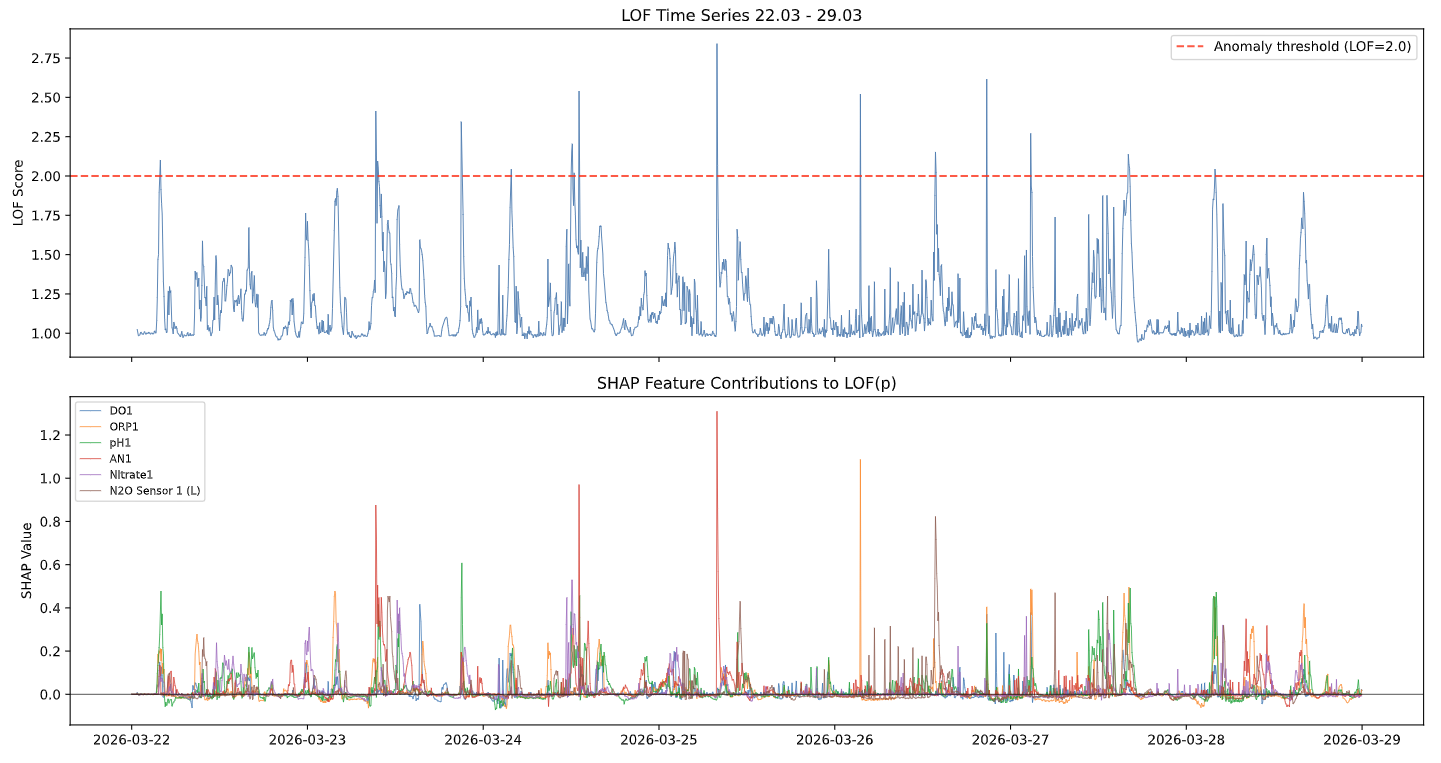
This project develops data-driven methods to monitor and control aeration processes in wastewater treatment using high-frequency sensor data. It focuses on detecting anomalies, identifying operational changes, and transforming raw sensor data into actionable insights for improved process understanding and control. Machine learning techniques such as anomaly detection and changepoint analysis are used to interpret complex and noisy time-series data from aeration tanks, supporting more reliable and responsive plant operation.
WHY IT MATTERS
- Enables real-time detection of faults and abnormal behaviour in aeration systems
- Improves the reliability of high-frequency sensor data in operational environments
- Supports identification of operational shifts (e.g. seasonal or load-driven changes)
- Provides early warning of sensor or process failures before they impact performance
- Enables data-driven decision support for plant operators
- Reduces reliance on manual interpretation of complex time-series data
- Forms the foundation for intelligent and adaptive control systems in wastewater treatment
ABSTRACT
Secondary treatment is one of the most expensive steps in wastewater treatment, requiring a huge energy demand for aeration. Efficient management of this aeration process requires granular (up to per-minute) data beyond dissolved oxygen readings. New in-situ sensor technology allows for high-frequency sampling which can help address inefficiencies in this process. This creates an abundance of data which needs suitable digital infrastructure to store, process, manage, and use for a variety of tasks.
Sampling from a mixing tank leads to an abundance of sensor noise. This is in largely due to hydrodynamics within the tank, and solids that accumulate during secondary treatment. Simple methods are often not sufficient to prevent all erroneous data. For example, sensors can sometimes become inoperational, and build-up of rag may lead to a sustained period of anomalous data. This can lead to poor performance of data-analysis and modelling processes which may influence plant operation. State-of-the-art anomaly detection methods are required to flag these for intervention.
Aeration processes can be broken into distinct phases of operation, most simply, blowers-on and blowers-off. Beyond this there are distinct phases within nitrification/denitrification processes. Blower set points are often altered based on seasonal variations, and periods of heavy rainfall or heat can also affect aeration processes. A posteriori detection and analysis of sudden shifts in the data may inform decision making. Live detection of changepoints with as little delay as possible may also inform changes to the blower operation, and flag models for refitting/retraining to prevent context drift.
This research is concerned with the investigation and evaluation of anomaly detection, changepoint detection, and machine-learning based modelling of sensor data from aeration tanks. Focus is placed on interpretable and lightweight methods. The final goal is an end-to-end data collection to insight framework using these methods alongside a central database for storing raw data/model outputs, and a dashboard.
Supervisors:
Dr Eoghan Clifford, Ph.D, Civil Engineering, University of Galway
Dr James McDermott, B.Sc., PhD, Computer Science, University of Galway

Ronan Timon | Research Assistant
Ronan is a researcher at the National University of Ireland, Galway, in the Data Science Institute. His research focuses on water resource recovery facility (WRRF) sensor monitoring to detect anomalies, segment operational phases, and identify changepoints in noisy, non-stationary time series data. In particular, he is interested in multi-changepoint detection via time-series segmentation, and graphical models of sensor network structures to improve understanding of secondary treatment processes. He develops and deploys interpretable methods that are light on computing power for easy understanding and use, favouring classical statistical approaches over heavier black-box alternatives where appropriate.in Connect with Ronan
Publications
Timon, R., Sweeney, R., Singh Jamwal, V., Dalton, C., Rodrigues, B., Clifford, E. and McDermott, J. (2026) Segmentation of Wastewater Treatment Sensor Data International Congress on Environmental Modelling and Software (iEMSs), University College Dublin, Dublin, Ireland.
Timon, R. and McDermott, J. (2026) Offline Changepoint Annotation to Online Changepoint Detection: A Framework for Wastewater Treatment Sensor Data International Conference on Time Series and Forecasting (ITISE).
Timon, R., Singh Jamwal, V. and McDermott, J. (2026) Segmentation for Gaussian Graphical Models on Wastewater Sensor Data CAESAR Workshop, European Conference on Machine Learning and Principles and Practice of Knowledge Discovery in Databases (ECML PKDD).