-
Courses

Courses
Choosing a course is one of the most important decisions you'll ever make! View our courses and see what our students and lecturers have to say about the courses you are interested in at the links below.
-
University Life

University Life
Each year more than 4,000 choose University of Galway as their University of choice. Find out what life at University of Galway is all about here.
-
About University of Galway

About University of Galway
Since 1845, University of Galway has been sharing the highest quality teaching and research with Ireland and the world. Find out what makes our University so special – from our distinguished history to the latest news and campus developments.
-
Colleges & Schools
Colleges & Schools
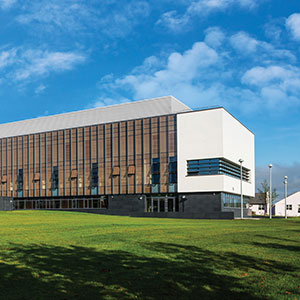
University of Galway has earned international recognition as a research-led university with a commitment to top quality teaching across a range of key areas of expertise.
-
Research & Innovation

Research & Innovation
University of Galway’s vibrant research community take on some of the most pressing challenges of our times.
-
Business & Industry
Guiding Breakthrough Research at University of Galway
We explore and facilitate commercial opportunities for the research community at University of Galway, as well as facilitating industry partnership.
-
Alumni & Friends
Alumni & Friends
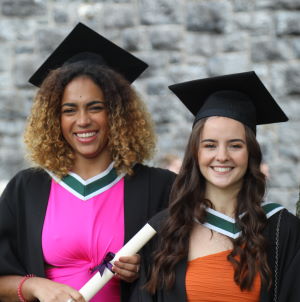
There are 128,000 University of Galway alumni worldwide. Stay connected to your alumni community! Join our social networks and update your details online.
-
Community Engagement
Community Engagement
At University of Galway, we believe that the best learning takes place when you apply what you learn in a real world context. That's why many of our courses include work placements or community projects.
 Accessibility & Language
Machine Learning for Wastewater Treatment Plant Operation
PROJECT OVERVIEW
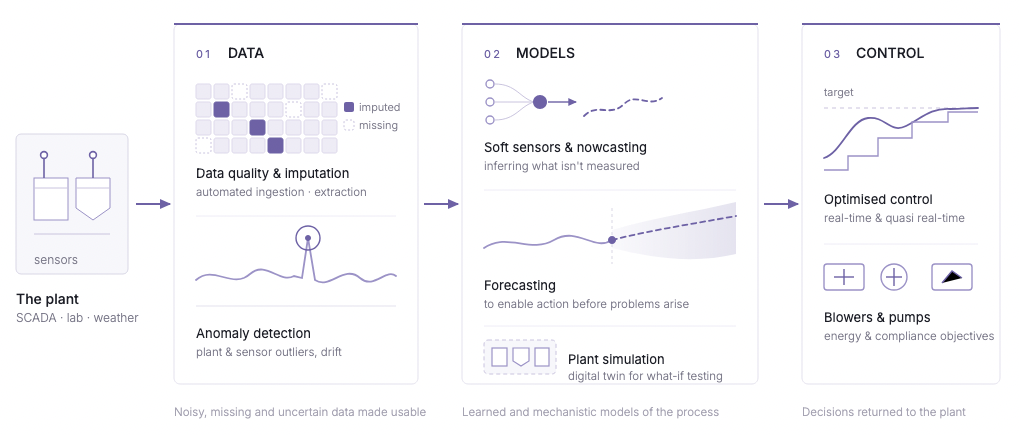
The WWTP-ML project develops machine learning methods to improve the operation of wastewater treatment plants through better use of operational data. It focuses on building robust data pipelines and AI models that can handle noisy, incomplete, and uncertain sensor data commonly found in real plant environments. The research supports fault detection, predictive maintenance, and data-driven decision-making, while also exploring approaches for real-time and near real-time process monitoring and control.
WHY IT MATTERS
- Wastewater treatment plants generate large volumes of complex, imperfect data that is often underutilised
- Faults in sensors or processes can go undetected, affecting compliance and efficiency
- Improving data quality and interpretation enables more reliable plant operation
- Predictive maintenance helps reduce unexpected failures and operational downtime
- AI-based tools support better decision-making for plant operators and engineers
- Enables a shift toward more automated, resilient wastewater treatment systems
- Provides a foundation for scalable digital infrastructure for future smart water systems
ABSTRACT
Machine learning is increasingly being applied to wastewater treatment to improve monitoring, control, and operational efficiency. However, real-world plant data is often noisy, incomplete, and uncertain, limiting the effectiveness of traditional analytical approaches.
The WWTP-ML project, funded by Ward and Burke Construction Ltd., Insight Research Ireland Research Centre, and the Ward and Burke Centre for Infrastructure Research and Innovation, addresses these challenges by developing robust machine learning methods for wastewater treatment plant operation. The project is co-led by Prof. Eoghan Clifford (Civil Engineering) and Dr James McDermott (Computer Science), University of Galway.
The research focuses on three key areas: (i) developing automated data ingestion and preprocessing methods capable of handling missing and inconsistent sensor data; (ii) implementing anomaly detection and predictive maintenance techniques to identify faults in both plant processes and sensing equipment; and (iii) exploring real-time and near real-time modelling approaches for improved forecasting, simulation, and operational control.
By integrating data engineering, machine learning, and domain-specific process understanding, the project aims to enable more reliable, efficient, and intelligent operation of wastewater treatment systems, supporting the transition toward data-driven infrastructure management.
Principal Investigators:
Dr Eoghan Clifford, Ph.D, Civil Engineering, University of Galway
Dr James McDermott, B.Sc., PhD, Computer Science, University of Galway
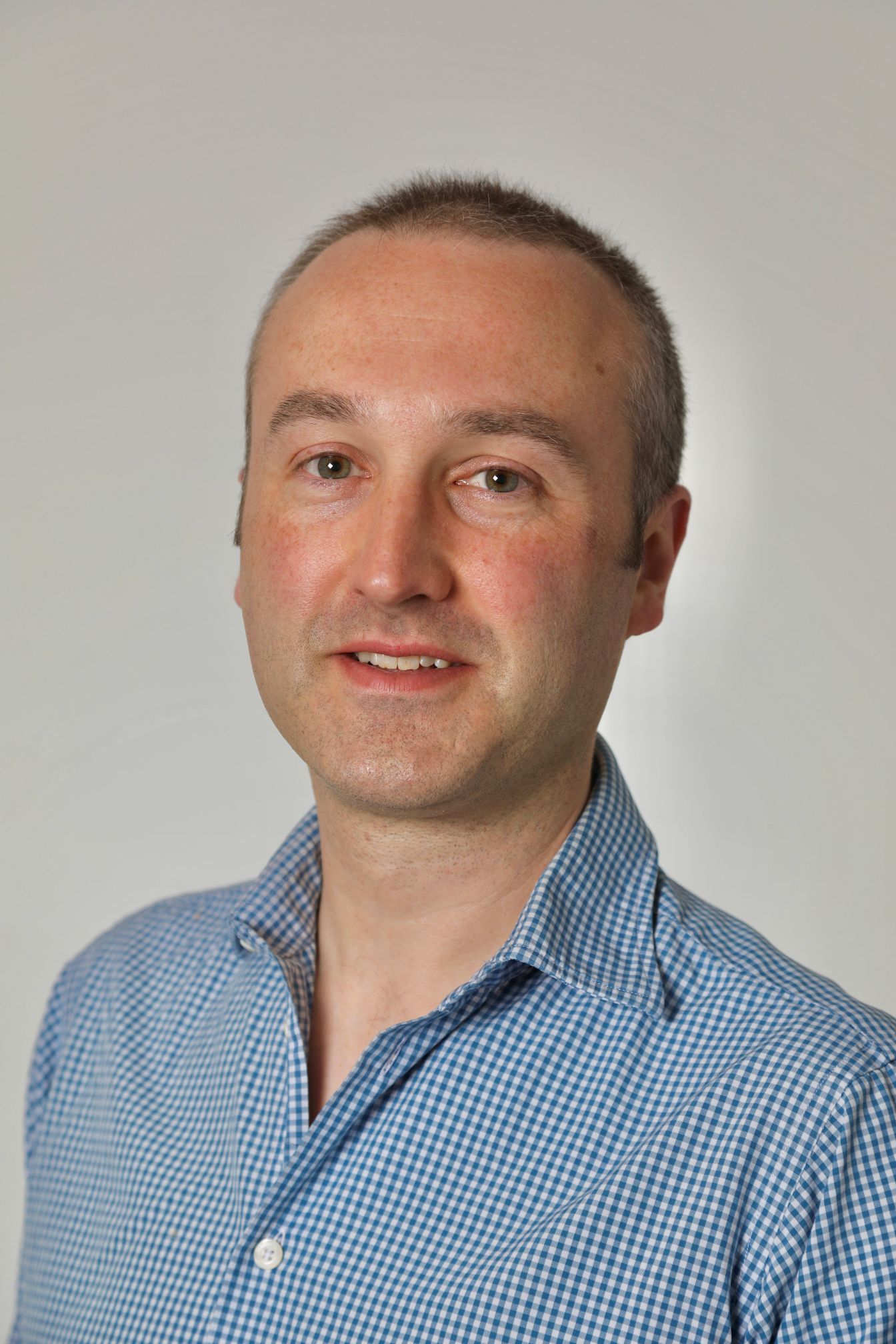
James McDermott | Senior Lecturer and Director of Research & Graduate Studies
James McDermott is Senior Lecturer and Director of Research & Graduate Studies in the School of Computer Science, University of Galway, Ireland. He has previously worked and studied in Hewlett-Packard, University of Limerick, University College Dublin, and Massachusetts Institute of Technology. His research interests are in artificial intelligence, including genetic programming, evolutionary optimisation, and deep learning, with applications in sustainability and AI music. He has chaired international conferences including EuroGP, EvoMUSART, and GECCO GECH Track, and is a member of the Genetic Programming and Evolvable Machines journal editorial board, and associate editor of the ACM SIGEvolution newsletter.in Connect with James