-
Courses

Courses
Choosing a course is one of the most important decisions you'll ever make! View our courses and see what our students and lecturers have to say about the courses you are interested in at the links below.
-
University Life

University Life
Each year more than 4,000 choose University of Galway as their University of choice. Find out what life at University of Galway is all about here.
-
About University of Galway

About University of Galway
Since 1845, University of Galway has been sharing the highest quality teaching and research with Ireland and the world. Find out what makes our University so special – from our distinguished history to the latest news and campus developments.
-
Colleges & Schools
Colleges & Schools
University of Galway has earned international recognition as a research-led university with a commitment to top quality teaching across a range of key areas of expertise.
-
Research & Innovation

Research & Innovation
University of Galway’s vibrant research community take on some of the most pressing challenges of our times.
-
Business & Industry

Guiding Breakthrough Research at University of Galway
We explore and facilitate commercial opportunities for the research community at University of Galway, as well as facilitating industry partnership.
-
Alumni & Friends

Alumni & Friends
There are 128,000 University of Galway alumni worldwide. Stay connected to your alumni community! Join our social networks and update your details online.
-
Community Engagement

Community Engagement
At University of Galway, we believe that the best learning takes place when you apply what you learn in a real world context. That's why many of our courses include work placements or community projects.
 Accessibility & Language
INPACT
National climate policy, greenhouse gas emissions and atmospheric outcomes in Ireland
About the project
Ireland is legally committed to reducing greenhouse gas emissions by 51% by 2030 compared with 2018 levels and achieving climate neutrality by 2050. It must also reduce emissions covered by the EU Effort Sharing Regulation by 42% by 2030 compared with 2005. However, current projections indicate that these targets may not be achieved. The INPACT project addresses this challenge by examining whether climate policies have produced measurable changes in Ireland’s atmospheric emissions. It evaluates carbon dioxide, methane, nitrous oxide and fluorinated gases while accounting for other influential factors, including economic activity, meteorology, agriculture, land use, technological change and long-range atmospheric transport.
INPACT combines policy analysis, national and gridded emission inventories, atmospheric observations and advanced statistical methods. The project develops a structured timeline of climate policies since 1992, compares bottom-up inventories with top-down estimates derived from atmospheric measurements, and analyses long-term records from Irish monitoring stations. Statistical and causal-inference methods are used to detect emission trends, estimate what might have occurred without specific policies, and assess intended and unintended environmental, economic and social effects. These datasets and results will be integrated into an automated, interoperable data system with transparent metadata and provenance.
Digital tools
A central output of INPACT is a pair of open, browser-based tools that make the project's evidence base directly usable by policymakers, researchers and the public.
Ireland Greenhouse Gas Policy Impact Explorer
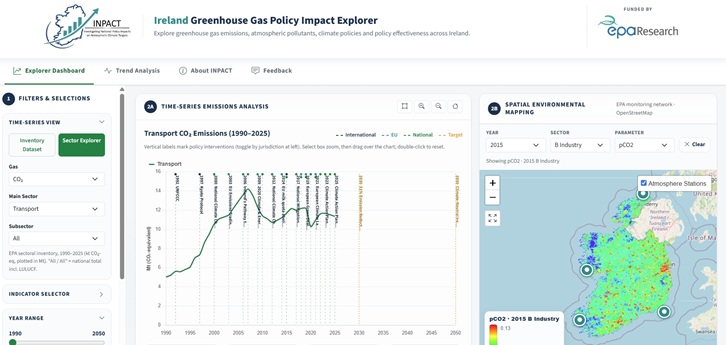
The Explorer places Ireland's emission inventories, atmospheric data and climate policy record on a single interactive timeline, allowing policy interventions and atmospheric outcomes to be viewed side by side. Users can explore national emissions from 1990 onwards by gas, sector and subsector; overlay policy implementation dates grouped by international, EU and national jurisdiction; and view statutory 2030 and 2050 targets as reference lines.
The dashboard also provides a spatial emission mapping, a policy intelligence panel giving structured detail on each intervention, a navigable 1992–2050 climate policy roadmap, headline policy effectiveness metrics derived from interrupted time-series modelling, a national climate targets summary, and an anonymous public feedback facility used to contextualise perceived against measured policy effectiveness.
Structural Break Analysis Dashboard
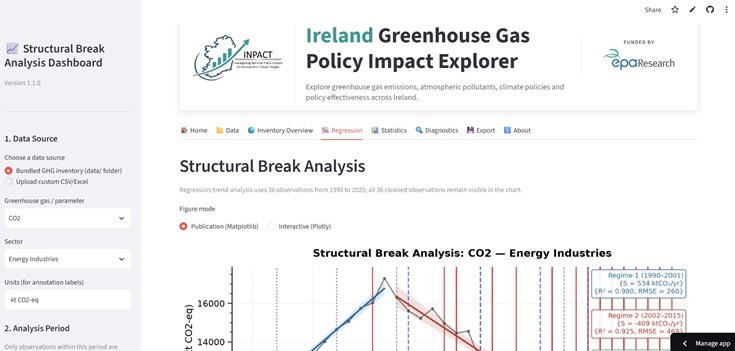
This Streamlit-based analytical companion allows users to test directly whether the statistical structure of an emissions series changes around a policy intervention. Rather than fitting a single trend across three decades of data, it fits separate trends to user-defined periods and tests whether the difference between them is statistically meaningful.
The platform supports comprehensive statistical analysis through configurable gas, sector and subsector selection; policy-aligned breakpoints; OLS, Huber and Theil–Sen regression; Mann–Kendall and Sen’s slope tests for entire and segmented time series; adjustable confidence intervals; residual diagnostics; and exportable results and visualisations.
Together, the two tools offer a graduated route into the same evidence base — the Explorer for orientation, communication and public engagement, and the Structural Break Analysis Dashboard for reproducible statistical testing.
Work Packages
INPACT is delivered through six interrelated work packages. WP1 develops a timeline and structured dataset of national policies affecting emissions and greenhouse gas concentrations since 1992. WP2 identifies discrepancies between bottom-up and top-down emission inventories to elucidate gaps in understanding of emission rates and sources. WP3 determines whether the identified policies have had a significant causal effect on emissions, atmospheric composition and radiative forcing, and identifies unintended impacts. WP4 builds the automated data system and public-facing digital tools that harmonise policy, emissions and atmospheric data. WP5 delivers scientific and policy dissemination, and designs and pilots public workshops on the facilitators of and barriers to emission reduction measures. WP6 coordinates delivery, convenes the project Steering Committee and maintains alignment with EPA priorities.
Expected outcomes
INPACT will deliver an integrated causal assessment of Ireland’s climate policy effectiveness, supported by an open policy timeline from 1992 to the present. The project will compare bottom-up and top-down emission estimates, analyse long-term atmospheric and climate trends, and assess the wider environmental, economic and social effects of climate policies. Key outputs will include two open digital tools, a public workshop framework, peer-reviewed publications, conference presentations, policy briefings and accessible summaries—strengthening evidence-based climate policy and supporting Ireland’s transition to net zero.
Project team
INPACT is led by researchers at the Centre for Climate and Air Pollution Studies (C-CAPS), Ryan Institute, University of Galway, in partnership with the J.E. Cairnes School of Business and Economics and the Insight Research Ireland Centre for Data Analytics.
Core project team:
- Dr Liz Coleman — Principal Investigator, University of Galway
- Professor Karyn Morrissey — Co-Principal Investigator, University of Galway
- Dr Mehdi Gholamnia — Postdoctoral Researcher, University of Galway
- Andy Donald — Data Science and Applied Innovation, Insight Research Ireland Centre for Data Analytics
Funding agency
INPACT is funded by the Environmental Protection Agency (EPA) Ireland under the EPA Research Programme.
The EPA Research Programme is a Government of Ireland initiative funded by the Department of the Environment, Climate and Communications.
-350x138.jpg)
Contact us
For collaboration opportunities and related enquiries, please contact the INPACT Project Team or Dr Mehdi Gholamnia, Postdoctoral Researcher.
mehdi.gholamnia@universityofgalway.ie
School of Natural Sciences, Physics – StreamAIR Laboratory (Room PHY209),
University of Galway, Galway, Ireland